Administration removed Professional Learning Communities (PLCs) for the 2025-26 school year last December as part of the district’s efforts to reduce the budget deficit. The removal of PLCs, along with the closure of Valley View Elementary, discontinuation of the Spanish Immersion Program, increases in rental rates and other efforts decreased the expected budget shortfall for 2025-26 of $6.3 million.
PLCs were first introduced for core subject teachers at the Eanes middle and high schools as a designated planning period for alignment and collaboration. Teachers still have their lunch and conference periods, but instead of PLCs, teachers now teach an additional sixth class. Unlike conference and lunch periods, PLCs were the same class period for all teachers across the same department, enabling teachers to discuss curriculum, analyze test results and collaborate with their colleagues.
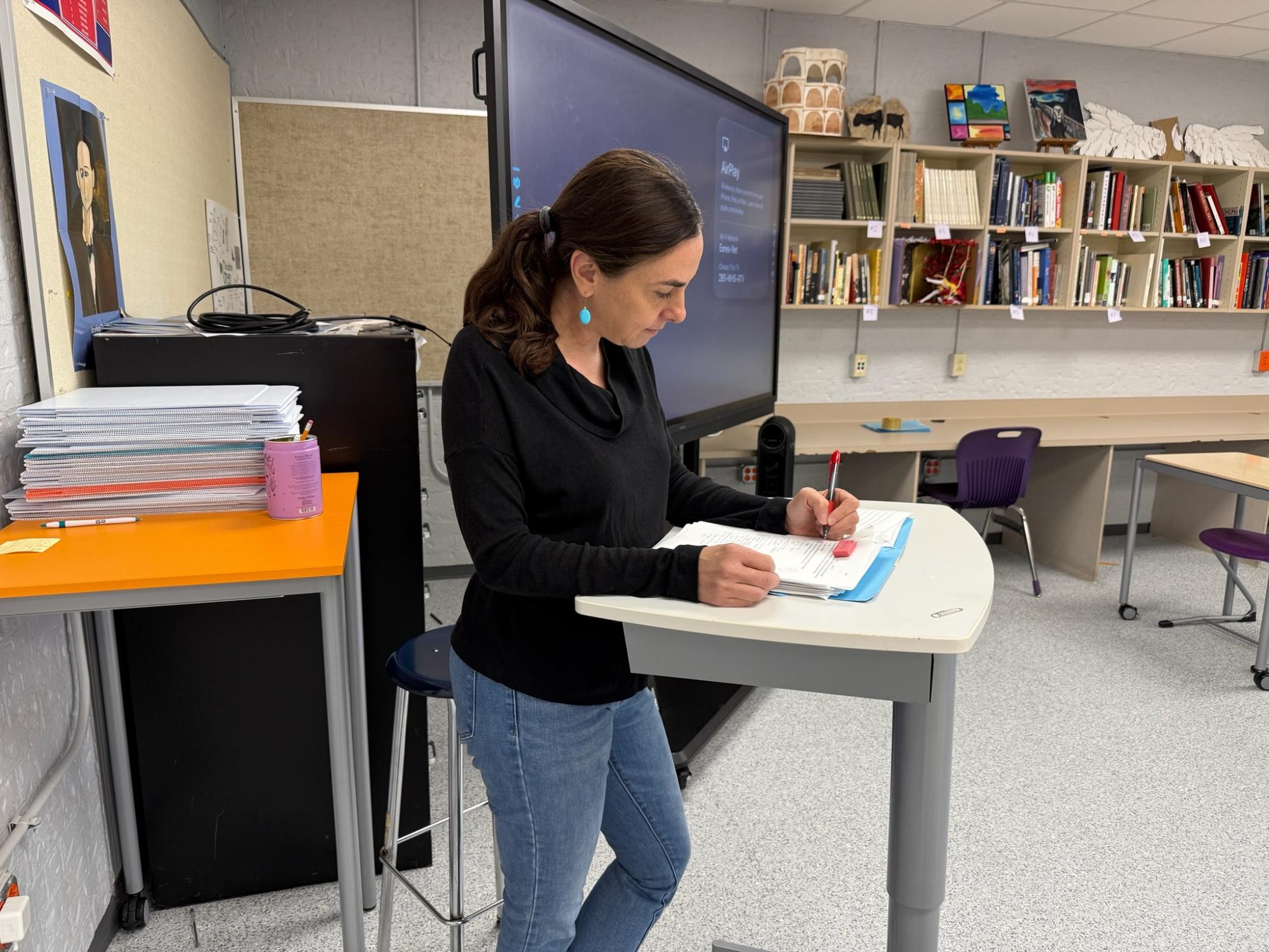
Some teachers expressed increased stress from the loss of planning time and the load of teaching an additional class, as well as concerns regarding maintaining the same level of instruction in the future. Science department chair, AP Chemistry and Organic Chemistry teacher Denise DeMartino said she feels “very pressured” in the time she is on campus after these changes.
For the 2024-25 school year, DeMartino had around 140-150 students. With an additional class, DeMartino has around 170 students this year. With the increased workload, DeMartino said she has to be “very deliberate in every minute of the day.”
“I find myself having to set more boundaries when students need help,” DeMartino said. “I’ve had to cut down on my availability – which I think will negatively impact students overall – but for my own ability, with the hours [per] day I have to get things done, I’m needing to do that. … My workload at home has increased, and the time that I can spend with students during the day has decreased.”
For other teachers like English department chair and English II Honors teacher Jeff Montgomery, who has been teaching in Eanes for 29 years, the removal of PLCs is “a challenge [the district] has to go through,” but not one he believes will lower the quality of education students receive. Math department chair and AP Calculus BC teacher Jocelyn Bixler, who has taught at Eanes for 28 years and has had an additional sixth class for the last three years, shared similar thoughts.
“It just takes a while to get organized and get used to a change,” Bixler said. “It’s a change, but that’s what life’s about.”
In efforts to still provide teachers with planning time within their department, the district has added additional early release days. Bixler noted that the designated PLC time this year is “not equal, not anywhere close,” to last year, “but it’s better than nothing.”
In the chemistry department, PLCs allowed teachers to analyze test, quiz and lab results to identify where students may need additional instruction. Now without the designated period, chemistry teachers are unable to analyze student work to the same depth.
“I’m not really looking at quality of student work as closely,” DeMartino said. “I don’t have time to open up every single lab two or three times to figure out what part of this lab they are having issues on. I’m still kind of keeping my eye on it, but not in the way I have in the past.”
In the math and English departments, teachers utilized the PLC periods to ensure curriculum and grading is consistent among classes. The lack of a PLC period has affected how AP English III and English III teacher Kathleen Murphy navigates her first year teaching juniors.
“Collaborating for grading is something I feel like we haven’t done as much of this year,” Murphy said. “I don’t love that because [with teaching] two new [classes], I really want that. Like, am I being too harsh? Am I being too kind? Am I giving the feedback I need? … It feels a lot more like I’m on my own.”
Even in subjects where teachers may be the only one teaching their specific class, the PLC period and built-in collaboration time was still used. The physics department, for example, has classes in which only one teacher teaches the specific class. However, the teachers still utilized the PLC period to work through questions students asked and collaborate with their peers to establish how to better explain concepts.
Teachers also collaborated with teachers of different classes along the same track, such as Chemistry Honors and AP Chemistry or AP Physics 1 & 2 and AP Physics C, to ensure consistency across years and identify the skills that may need additional attention for students to succeed in the subsequent courses.
Beyond planning and meeting with colleagues, the PLC periods provided teachers with additional time some used for writing letters of recommendation, sponsoring student clubs and other efforts to further support students.
“That October period was the hardest period of my professional life when those rec letters were due,” Geometry Honors and AP Precalculus teacher Edgar Walters said. “I had so many to write this year, and I was trying to juggle a lot of classes. It was an extremely difficult period in my professional career.”
Teachers are working around the PLC removal in different ways to maintain collaboration with their teams without the designated time in the school day.
“We want to maintain that continuity between our classes, so that it’s fair to all of our students between the classes,” Montgomery said. “Finding that moment to meet every day helps us maintain that continuity. Even if it’s sacrificing a little bit of lunch time or a little bit of planning time, we still find a way to make sure that we see each other every day, to make sure that we’re all on the same page.”
For some teachers, like Walters, adjusting to the PLC removal this semester involves schedule changes that benefit personal needs apart from making room to meet with teams.
“I noticed that I personally am getting to school a lot earlier this year,” Walters said. “I’m usually in the building about 30 minutes earlier than I was in previous years, because I kind of need that quiet time to get ready for the day.”
For others, it means discussing with their coworkers via email. However, Physics and Modern Physics teacher Scott Horton noted that the virtual collaboration is different from the face-to-face conversations they had during PLC periods. Horton noted that even with shared lunch periods, without the PLC periods, discussions surrounding student questions that would have previously taken three days may now occur over a month.
“The actual time spent solving the problem probably wasn’t that different,” Horton said. “It was still only a couple hours, but that couple hours was spread over a month instead of a week. … If I don’t have a good answer for someone on Monday and I come back on Wednesday, … students have good feedback for it. If I come back a month later, … that immediate feedback gets lost.”
DeMartino said it is difficult to fully hash out ideas and gauge how her peers feel about a certain idea through email compared to in-person conversations.
Some classes, such as AP Chemistry and Physics, already have an established curriculum they developed over the years and during PLC periods. Teachers have been able to rely on their curriculum from previous years to ease their workload and the transition to six classes and no PLC period.
“We know our system, we already have a really good backbone,” DeMartino said. “If we didn’t have that already done, I think we’d be in a lot worse situation than we are now. We all work so well together … I think where this is really hard is for teachers who don’t have that relationship already established.”
However, teachers for newer, developing classes, such as AP Precalculus, are still adjusting their curriculum. AP Precalculus was added as an AP course by College Board two years ago, and teachers are still figuring out how to translate the College Board curriculum to their classrooms.
“This year … we made a big revamp to our first unit, and we were really proud of that and it went quite well, but it was exhausting,” Walters said. “And while we were very proud of that work, it was not sustainable. We basically said, ‘Okay, we were able to do that for unit one, but we cannot do that same level of work for the rest of the school year.’”
Additionally, some teachers of classes with already established lesson plans and assessments expressed concerns about courses becoming “stagnant” throughout future years due to the lack of time for them to meet and identify areas of improvement. Some teachers are worried a stagnant curriculum could negatively impact students as time goes on.
“You kind of question how long is that sustainable,” former AP US History teacher Cathy Cluck said. “You’re not able to be creative or change things, or have a chance to really kind of sit down and think about what is working with this particular group of kids.”
Normally, adjustments are made to the curriculum every year to adapt to the “normal evolution” of students, as DeMartino describes it. Additionally, changes to AP courses and curriculum by College Board or the district changes – such as the switch from Google Classroom to Canvas for all teachers next year – require teachers to adjust to new parameters.
“What’s lacking for us is creative change and moving with [the] times,” DeMartino said. “We [are] just pretty much doing exactly what we did last year, which is fine for a year or two, but at some point we’re really going to need to evolve.”
Horton noted that while he does not believe stagnant curriculum would have a large impact on students, he believes the loss of time to analyze what did or did not work in the classroom will impact his ability to improve as a teacher.
“I thrive as a teacher when I’m changing things [and] I’m invested in the lesson because I did something new and I want to see how this goes,” Horton said. “I feel that personally if I’m not invested, then my students aren’t invested in the lesson. For me personally, I am trying to always change [my lessons] and make it better because that’s how I stay invested in my course. I want to be invested in my course so that my students can feel that investment.”
Other teachers enjoy the more creative and original lessons that PLCs provided time for teachers to develop. Cluck noted that the opportunity for creativity and the chance to bounce ideas off of her co-workers was very important to her in her 32 year teaching career.
“A lot of my favorite class days of the year come from things sort of outside the traditional curriculum,” Walters said. “[Like], how can we make that review day something a little more engaging? That doesn’t come straight from a textbook or from whatever curriculum you might be using. [It’s] the product of passionate, smart teachers, sitting in a room together and brainstorming those ideas, and we just don’t really have time [for that] this year.”
While reducing the opportunities for teachers to collaborate on curriculum during the school day, teaching a sixth class has also “made an issue where [teachers] don’t interact as much,” according to Bixler. Extra grading and other duties have teachers preoccupied, making day-to-day interaction with peers a less common occurrence.
“It’s a big hit [that] I can’t talk to the people that I like talking to and spending time with and working with,” Horton said. “I feel like we have a really, really good team, particularly here in physics. The fact that I don’t get to sit down and work with them regularly, it’s hard. It’s hard feeling a little bit more isolated [and] like I am, for lack of a better way of putting it, the only adult in the room for eight hours. That is not an ideal experience.”
Cluck said the “new laws and parameters and lack of PLC” played a part in her decision to retire.
“I absolutely think it was the right time for me to go,” Cluck said. “It makes me sad because I loved this career, but the external pieces that keep getting added onto the classroom teachers, I’m like ‘There’s not enough of the payoff.’ For me, it was time to go.”
DeMartino said that this is the first year she has called the Teacher Retirement System to see her current status, as she is eligible to earn her pension and retire.
“It wasn’t in my plan, but this is the first time I’ve looked into it, and I’m trying to decide what’s best for me,” DeMartino said. “The point where I’m not happy [teaching] is the point where I will leave. The students are the ones that make me want to be here, but it’s starting to be outweighed by the pressure and the amount of work and the additional expectations. … It’s not just Eanes, [but] the profession across the board because of the demands placed on the districts by the state, [which] in turn affect our classrooms.”
Eanes’ removal of PLC periods follows a wider trend among public schools in Texas to combat increasing budget challenges. Based on experience working in other school districts who also cut programs similar to PLCs, the effects of the PLC removal will “go one of two ways,” according to Murphy.
“Either people start to do more of their own thing, and there’s more of a divide and less consistency across the … curriculum,” Murphy said. “Or there’s going to be heavier oversight, and there’s going to be less teacher autonomy [in] customizing these lessons to what we do.”
While the removal of PLC periods and an increase in state funding helped to reduce Eanes’ budget deficit for the 2025-26 school year, the district still faces a projected $5-6 million budget shortfall in 2026-27. Proposed efforts to balance the budget include increasing savings through staffing optimization in both the elementary and secondary schools and the central administration, and salary freezes. Community members expressed concerns in a Thought Exchange that the proposed measures would further decrease teacher morale.
“Our district has tried to deal with [the budget shortfall] in the best way they can to keep everybody happy,” Bixler said. “People are going to be unhappy for a little while, and then they’ll figure it out.”
Bixler has found that making small changes, like an additional work day for students to work on AP practice or classwork, can help teachers find more time to grade as they fully adjust to the new schedule. She also noted that while some teachers “were frantic at the beginning of the year,” she has noticed “a big shift in their calmness” as teachers get used to the new schedule.
Montgomery emphasized the importance of keeping the same quality of instruction with six classes as he did last year with five classes and a PLC. He said that “compromising personal integrity when it comes to teaching is not an option,” and teachers will figure out how to work around challenges and maintain the same level of teaching.
“Hopefully we get a PLC back at some point,” Montgomery said. “But until then, we just have a good group of teachers around who are willing to get the job done. That’s the most important part.”