Eanes administration presented four initial packages to address the projected $5-6 million deficit for the 2026-27 school year at the school board meeting last Tuesday. Each package is a combination of the five budget-saving solutions introduced Oct. 21 and open to change based on feedback from the school board and community.
“None of these are enjoyable things or positive things, but it’s the reality of where we are and it’s not just us,” interim Superintendent of Schools Dr. Tom Trigg said to the board. “I feel like the process we put into place [is] very valid. Now, as we begin to work with all seven of you, I’m really confident that we’re going to be able to come up with an optimization package that is what’s in the best interest of our kids going forward.”
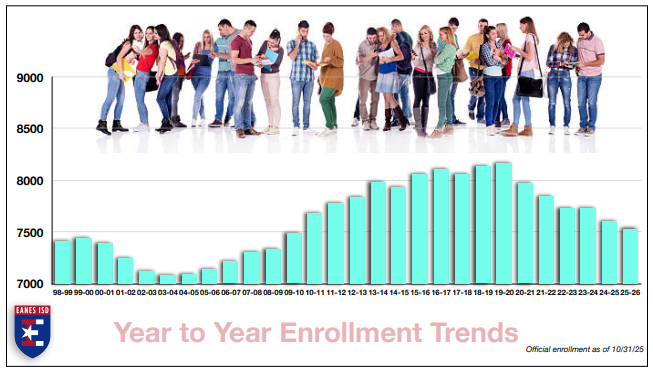
The deficit stems from state funding that has not kept up with inflation and declining enrollment rates, resulting in the elimination of Professional Learning Communities, closure of Valley View Elementary and the discontinuation of the Spanish Immersion program last year. Board member Diane Hern expressed concerns saying that if there continues to be a lack of action by the state legislature for public education funding, the district will “be here in groundhog day three and four years from now, and it’s going to just get worse and worse.”
The four packages presented focus on solutions that attempt to avoid impacting student experience in Eanes, and board members and administration discussed each option throughout the meeting.
“We’ve worked really hard to not present anything to you tonight that … would take away one of those unique experiences that you can have in Eanes ISD,” Chief Financial Officer Chris Scott said at the beginning of the presentation. “That’s not to say we’re not presenting things that [will] have any impact on students. We’re going to present several things that will impact students. But what we’re trying to do is make it as indirect as possible and impact those students as little as we can.”
Increasing Revenue and Staffing Optimization
All packages include efforts to increase revenue by adding additional transfer students, creating online courses and increasing facility rental rates by 10%, according to Scott.
Scott said most additional transfer students would come in at the secondary level, emphasizing any additional transfers at Barton Creek Elementary – the campus Valley View Elementary blended with after its closure – would be at the kindergarten level.
Each of the four packages include “staffing optimization” to increase savings by $2.4-3.3 million via attrition. According to Eanes ISD, approximately 87% of the budget is devoted to salaries and benefits, leading many of the cost-saving efforts to relate to staffing optimization.
The presentations included further details on what the staffing optimization would look like, including a central admin staffing review and changes to teacher-student ratios.
The central administration staffing review would save a projected $520,000 by reducing positions across central departments, consolidating a “very lean central administration” according to Chief Human Resources Officer Laurie Lee.
“We wanted to focus on those non-instructional roles so that we could at least not touch the campus as much as possible,” Lee said during the presentation.
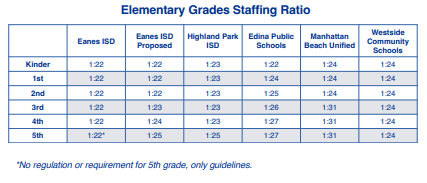
Staff optimization at the elementary school level includes a proposed adjustment to the 1:22 teacher-student ratio that is regulated across K-4 classes and used as a guideline for fifth grade classes. The adjustment would maintain the 1:22 ratio in K-2, and shift third grade ratios to 1:23, fourth grade to 1:24 and fifth grade to 1:25. The ratio would still be similar to other high-performing school districts like Highland Park ISD.
The changes implemented are projected to save another $520,000 through natural attrition, not staff eliminations. It could also involve shifting teachers around elementary schools based on needs and enrollment at each campus.
“We do believe by shifting the upper grades we can maintain our instructional quality,” Executive Director of Teaching & Learning Dr. Chad Burnett said while presenting proposed elementary staffing changes. “We can still provide our guaranteed curriculum and our interventions in the classroom. But also to note, we would be asking teachers to teach more kids and that does come with more work.”
Staff optimization at the secondary schools would decrease expenditures by a projected $2.015 million. The amount of staff at secondary schools is currently based on conversations with Human Resources, campuses and Teaching and Learning.
The staffing optimization would include adopting an enrollment to staffing divisor of 20 for general education staff, a divisor similar to other high-performing districts. The staffing ratios at the middle schools is currently equivalent to 17, and the staffing ratios at the high school is equivalent to 18.05. Staffing for special education would remain based on student needs, according to Dr. Burnett.
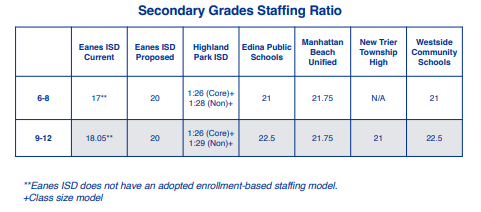
Adopting the staffing model will increase class sizes and a tighter master schedule, resulting in fewer singleton electives.
“When we talk about staffing optimization, it is on the backs of our staff and our teachers,” board president Kim McMath said to other board members. “[They] are, in my opinion, what make Eanes Eanes. Our students are fantastic students, but they get the foundation from our teachers. If we are not going to move into doing the hard things, then we are going to lose those teachers. … To ask them to continue to take on more and more and more without being able to get more from a monetary basis, they’re not doing this for free but sometimes with these tiny raises, it feels like we do not value them.”
Reduction Package One and Package Two
Package One and Package Two include program reductions and salary freezes or a reduction in raises in addition to revenue increases and staffing optimization, providing total budget reductions of $5.5-6.6 million or $4.7-5.8 million respectively.
Reducing programs and services is estimated to save $1-1.2 million by evaluating programs and services.
“This is not the elimination of any program, this is just looking at providing services and programs a little bit different,” Dr. Burnett said when introducing program reductions.
Administration based their projection on a district-wide evaluation of current student programs and services offered. Administration determined programs that would least directly impact students and identified areas that could be consolidated, restructured or scaled back to “save a little bit more money and to be efficient in still offering those programs,” Dr. Burnett said.
The specific programs that may be reduced have not been named. Dr. Trigg noted the “vague” wording during the presentation as intentional in order to be sensitive.
“It’s a significant change for those people involved,” Dr. Trigg said to the board. “We really didn’t want to talk about that publicly until we had a chance to talk to those individuals who are involved. … If this is one that we consense around that needs to happen, we will be revealing those specific programs at the appropriate time, but we will talk to the people first.”
During the meeting, board vice president Laura Clark asked the administration to keep the 2024-28 board priorities and Eanes ISD Graduate WHEEL in mind when evaluating programs as they are the “guiding line” and “framework” board members make decisions around. Among the board priorities are “academic growth through high-quality instruction” and “exploratory opportunities and a variety of pathways to increase post-secondary options.”
“When we talk about reducing programs, I wanted to make sure that we’re considering both the quantitative data – like the participation, the outcomes, the costs – and the qualitative values of these programs,” board secretary Kelly Marwill said to the administration. “The sense of belonging, student engagement, safety, just things that kids feel that make the difference for them.”
Board member Catherine Walker noted that Latin students have expressed concern about their classes, and encouraged students who may be worried about their programs to continue signing up for them in order for the classes to “be of size” and “be able to cover the cost of this class.” Walker emphasized that “all is not dire” surrounding the discussion of program efficiency, as rethinking how programs are run could potentially benefit students.
“I think this whole concept of program reduction is really just us pressure testing the desirability of a program, which is not necessarily a bad idea,” Walker said while discussing concerns of program reduction. “Are we giving students the programs that they’re asking for? If they’re not enrolling for it, then that gives us an opportunity to listen and learn why not.”
Package One would include a full salary freeze, reducing expenditures by $1.6 million. Package Two provides a 1% salary raise instead of the 2% salary increase currency budgeted for, saving $0.8 million. Board members expressed concern for what larger class sizes and no salary raise would do for teacher morale and retention.
“These are people and I just want us to listen to them,” board member James Spradley said to the board and administration. “I hope that with superintendent Koennecke that we can get into schools and have meetings with teachers and listen.”
Reduction Package Three and Package Four
Package Three includes a five-penny voter approved tax ratification election (VATRE) to adopt five copper pennies, increasing revenue and staffing optimization to provide $5.0-5.9 million in savings. Package Four is made of a nine-penny VATRE, increasing revenue and staffing optimization would reduce the budget $6.7-7.6 million.
The VATRE would begin with the board adopting a tax rate higher than the current voter approved rate in August, leading to a voter approval tax rate election in November. If the election fails, the tax rate will revert to the previous rate. The copper pennies the district could adopt would be subject to recapture by the state. The district has already adopted the eight golden pennies that are not subject to recapture.
According to Scott, the adoption of nine copper pennies would increase taxes around $1,500 per year for the average homeowner, increasing tax collection by an estimated $20 million, but only bringing $3.8 million into Eanes ISD. Five copper pennies would bring $2.1 million into the district.
Were the board and administration to proceed with Package Three or Four, teachers would receive their 2% salary raise if the VATRE passed. If the VATRE failed, teacher salaries would be frozen and both options would provide $4.5-5.4 million in savings.
Concerns regarding the VATRE focused around fiscal responsibility, uncertainty of one passing and how it may affect community perception of following bond elections.
“I don’t want to sit there and go, ‘Pass this VATRE or else our teachers don’t get a raise and we cut these programs,’” Spradley said at the meeting. “If our community makes a choice to pass a VATRE to fund our district with this money, I want it to be a choice they’ve made proactively in a positive direction, not a do-this-or-else kind of threat from the board.”
This November, there were 60 VATRE elections where 30 passed and 30 failed according to Scott. Scott also noted that there is a “definite difference” in the results of VATRE elections surrounding the adoption of golden pennies and copper pennies.
“The other option here is we do have a foundation that keeps 100% of our dollars in the district,” Hern said during discussion of a VATRE. “In the time span between this conversation and August when we adopt our tax rate, our voters could speak with those donation dollars and help us be in a different position potentially. Maybe it’s a different VATRE amount that we would need to pass to keep our raises where we want to keep them and keep our programs where we want to keep them. … We need to get out to our community and be motivated to help them understand the position that we’re in and why.”
Administration sent out a thought exchange through ParentSquare and StudentSquare Friday asking for community feedback on suggestions for revenue-generating ideas and perspectives on a potential VATRE. They encourage community members to share the survey link to residents who do not currently have students in the district to receive their feedback as well.
Results from the thought exchange will be presented at the Dec. 9 Regular Meeting. Discussion surrounding the budget will continue at the Jan. 13, 2026 meeting, before a plan to address the budget shortfall is finalized Jan. 27.
“We want to hear from our community,” Walker said during the meeting. “We want to hear from students, parents. We want to hear from people who live in the district. I think the one thing I’ve heard is ‘We want to balance the budget.’ So what is your preference? It’s really important for us.”