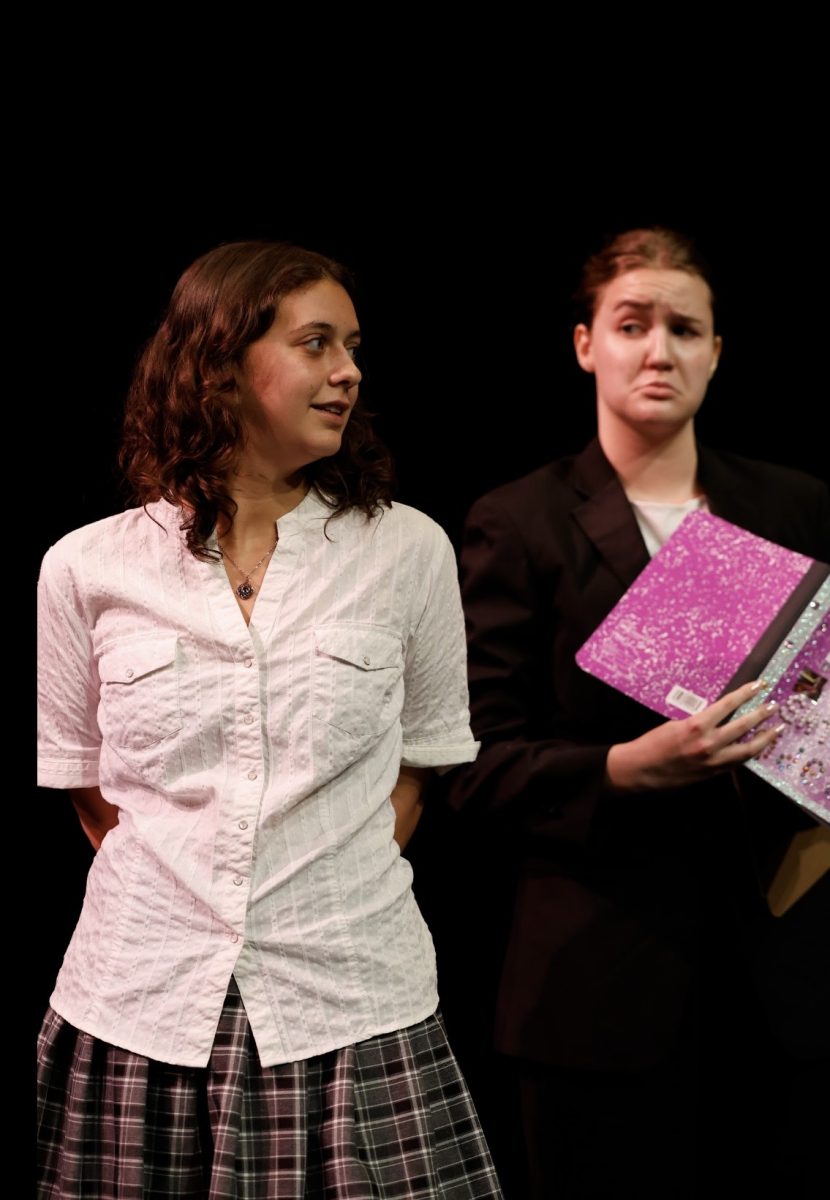
Last week, the theatre students performed “12 Angry Men” for English II classes. They took the courtroom drama from being analyzed on page to the stage. The production gave the English II students a chance to see the play they’ve been reading, and experience how interpretation, design and performance choices can reshape a classic.
The performance was marked by directorial decisions—like symbolic costume colors and a more physical ending—and by the actors’ own struggles and triumphs in bringing the script to life.
Following the performance, the cast hosted a Q&A session with the audience, where they discussed the characters and the creative decisions behind the production. The actors spoke about the emotional complexity of their roles. Junior Harrison Kuemmerle, who played Juror Three, described his character’s internal struggle.
“He’s just really frustrated, honestly,” sophomore Harrison Kuemmerle (Juror Three) said during the Q&A session, describing his character. “The whole thing is he wants to be right all the time, but he realized that he can’t be right in the situation.”
The discussion quickly turned to design choices. The Theater II students ran the technical side of the show. They explained why red appeared in the otherwise black-and-white costumes, talking about how it was a symbolic choice showing anger.
“The different amounts of red in the costume was kind of a fun thing for them to play with,” Yanchack said. “It got a little repurposed, but it worked.”
Directorial choices also shaped the ending, which some audience members noticed felt more violent than the script they had read.
“Act three in our version is like three pages long, so it had to go somewhere,” Yanchack said. “I think it’s better for a theater to show than just to let you assume stuff. More action is better – it probably kept you engaged, at least more than you normally would have been.”
For the actors, the process of preparing the play was just as intense as the performance itself.
“It was a process,” sophomore Claire Carsen (Juror Eight) said. “A lot of people were dealing with other theater stuff or extracurriculars when we got the script, so it kind of took a backseat. Off-book day- the first run-through without scripts- was tough; everyone was scrambling.”
Sophomore Julia Clebsch (Juror Ten) added that the script’s repetition made it difficult to keep track of the plot.
“It’s like an entire murder trial,” Clebsch said. “You really have to get in the headspace of, ‘I’m supposed to solve this.’ Once you outline the sequence of events, it gets easier.”
Despite the challenges, the actors agreed that the show came together in the final week.
“I didn’t know a lot of my lines until this week, which is not how you’re supposed to be,” Kuemmerle said. “But it all comes together in show week, and that’s the most important part.”
Theatre teacher and director Yanchak noted that the play’s stationary setting—a jury room—made it difficult to stage, but the students’ energy and creativity brought movement and tension to the performance. With rotating casts and bold design choices, the production gave the English II students a fresh perspective.